
Before You Invest Further in AI
BY GERARD BROSSARD, CEO AT DENISON CONSULTING
The Board-Level Case for Organizational Readiness
Move beyond isolated experimentation.
Build behavioral and organizational capacity.
Scale AI into operating-model improvement.
The boardroom AI question is changing
For many companies, the first question was: Do we have AI initiatives? That question is now insufficient. The more important question for CEOs and directors is: Can those initiatives change enterprise performance at scale?
That distinction matters because AI is not just a tool deployment. It changes decisions, workflows, roles, accountability, governance, and the psychological contract between employees and the enterprise. When the internal environment is ready, AI can accelerate strategy, learning, and execution. When the internal environment is not ready, AI can underdeliver, create confusion, and magnify existing weaknesses.
Why this is a board-level risk
Approving AI capital without a readiness view is like approving a major operating-model change without an execution risk assessment. Value creation depends on strategic clarity, decision rights, data and information flow, employee confidence, governance, workflow redesign, and change capacity.
In practical terms, boards should expect management to explain not only what AI tools will be used, but what must change in the organization for those tools to create value. If the answer is mostly about software, the plan is incomplete.
The readiness model CEOs should put on the agenda
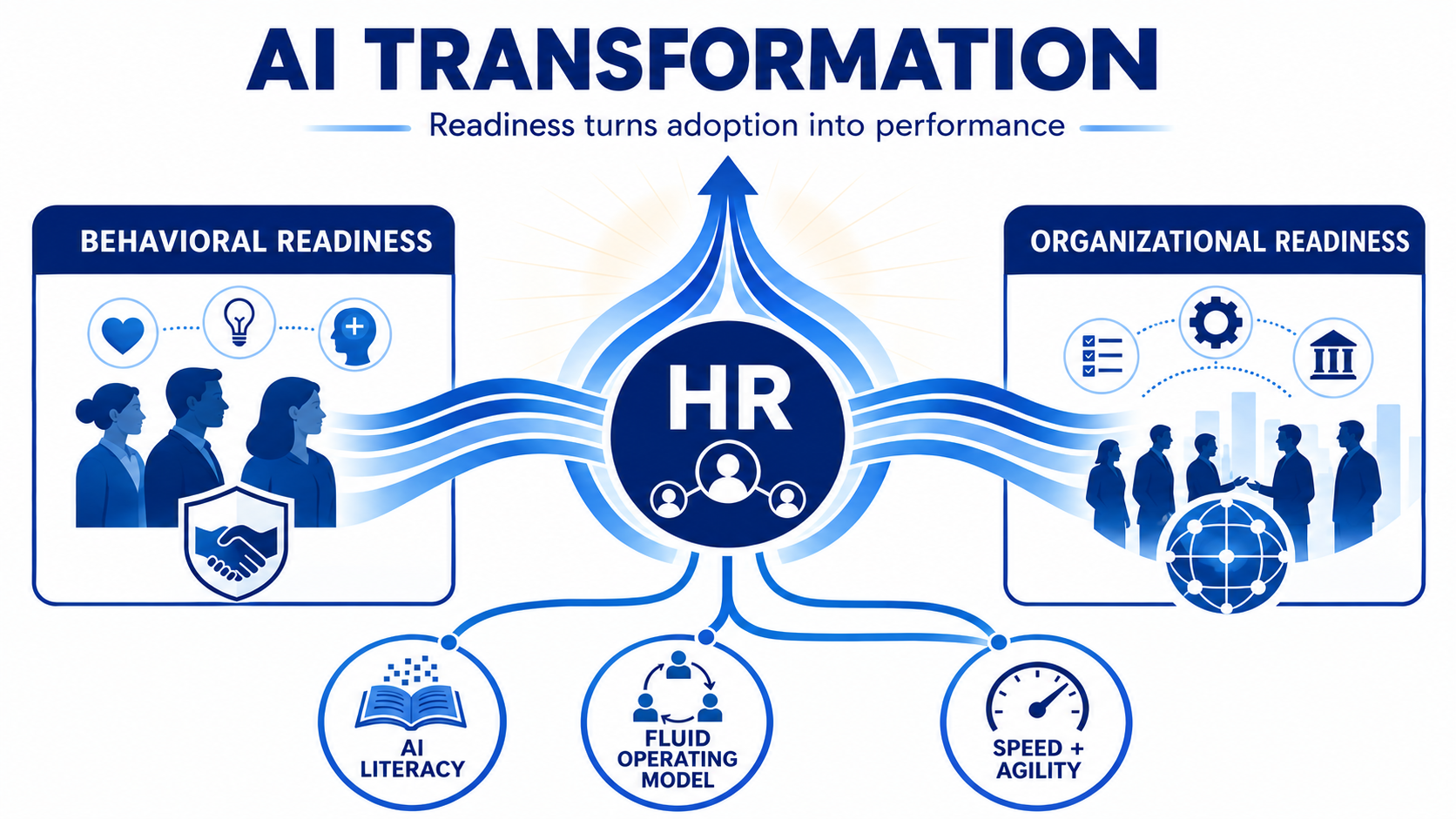
Denison’s AI Readiness Index frames readiness in two linked dimensions. Behavioral readiness asks whether people are prepared and willing to use AI. Organizational readiness asks whether the enterprise has the capacity to convert AI usage into scalable business impact.
Both dimensions matter. High employee enthusiasm without organizational scale capacity produces scattered experimentation. Strong governance and systems without employee adoption produce unused infrastructure. Scalable AI-enabled performance requires both.
| Low Organizational Readiness | High Organizational Readiness | |
|---|---|---|
| High Behavioral Readiness | Experimentation Without ScalePeople are trying AI, but the enterprise lacks the systems to convert usage into value. | Scalable AI-Enabled PerformancePeople use AI, and the organization can integrate, govern, coordinate, and scale that usage. |
| Low Behavioral Readiness | Low Adoption / Low ImpactPeople are hesitant, and the enterprise lacks the capabilities to overcome adoption barriers. | Scale Capacity Without AdoptionSystems exist, but people are not yet adopting or using AI with confidence. |
The board takeaway
Directors should not settle for a count of AI pilots. A pilot count tells the board that experimentation is happening. It does not tell the board whether the company has the capacity to integrate AI into decision-making, operations, customer value, risk management, and daily work.
Readiness clarifies where the enterprise is actually positioned. A company may have high behavioral readiness but low organizational readiness; employees are experimenting, but the business lacks shared metrics, integration, governance, and workflow redesign. Another company may have high organizational readiness but low behavioral readiness; the operating system exists, but people are hesitant, insecure, or insufficiently skilled. Each condition requires a different leadership response.
This is why a readiness diagnostic is more useful than a generic AI maturity label. It shows leaders what must change next.
What the AI readiness index makes visible
The AI Readiness Index is designed to move leaders from diagnostic insight to action. It does not simply generate a score. It points to specific conditions that must change for AI to create value.
| Behavioral Readiness – Can people adopt AI? | Organizational Readiness – Can the enterprise scale it? |
|---|---|
| AI optimismPeople believe AI can improve work, decisions, and outcomes. | Strategy and value governanceAI is tied to clear priorities, explicit objectives, success metrics, ownership, and accountability. |
| AI innovativenessPeople are willing to explore and experiment with AI-enabled ways of working. | Information and integrationInformation flows, decision rights, and cross-functional coordination enable AI to move beyond isolated pilots. |
| AI discomfort / controlPeople feel enough control and ease that AI does not trigger avoidance. | Capability and changeThe organization builds skills, redesigns workflows, enables managers, and embeds improved ways of working. |
| AI insecurity / trustPeople trust AI enough to use it appropriately when decisions matter. | Mission, adaptability, involvement, consistencyThe broader health system that aligns purpose, learning, engagement, and shared operating discipline. |
| AI capabilityPeople feel confident using AI tools relevant to their roles. | |
| AI encouragementLeaders create permission and support for responsible experimentation. |
From signal to intervention
| If the signal is low… | Targeted Intervention |
|---|---|
| Behavioral readiness | Build trust, confidence, fluency, and role-based skills through local leaders and credible manager enablement. |
| Strategy and value governance | Clarify AI priorities, ownership, use-case criteria, success metrics, and accountability for business outcomes. |
| Information and integration | Improve information access, decision rights, cross-functional coordination, and governance routines. |
| Capability and change | Invest in skill-building, workflow design, manager enablement, experimentation routines, and adoption of improved practices. |
A useful way to connect this to enterprise culture is through the broader Denison organizational health lens: Mission provides strategic clarity; Adaptability supports learning and iteration; Involvement builds empowerment and engagement; and Consistency enables shared values, coordination, and ethical scale. Together, these conditions determine whether AI is absorbed as a productive capability or remains an expensive experiment.
Five questions boards should ask before the next AI investment
The purpose of board oversight is not to slow AI down. It is to make sure speed is pointed at the right outcomes and supported by the right organizational conditions.
| Board Question | What Directors Should Listen For |
|---|---|
| What enterprise priority will this AI investment improve? | A clear link to growth, margin, quality, customer experience, risk, speed, or innovation – not tool adoption for its own sake. |
| What behavior will employees need to change? | Specific role-level changes in decision-making, workflow, judgment, review, escalation, and collaboration. |
| Where could AI get trapped in pilots? | Siloed data, unclear decision rights, weak coordination, lack of process ownership, or limited manager enablement. |
| How will we govern value and risk? | Use-case criteria, owners, success metrics, ethical guardrails, data quality expectations, and disciplined progress reviews. |
| What readiness gaps must be closed before scaling? | Trust-building, skills, workflow redesign, information flow, governance routines, or change capacity. |
A 90-day CEO agenda for AI readiness
| Timeframe | CEO / Executive Action | Board-Level Outcome |
|---|---|---|
| Days 0–30 | Run an AI readiness diagnostic across behavioral and organizational conditions. Map major AI use cases to strategic priorities, value pools, and risk domains. | A readiness baseline that distinguishes enthusiasm from scalable capacity. |
| Days 31–60 | Select the use cases most likely to create measurable value. Assign accountable owners. Clarify decision rights, workflow changes, metrics, and governance routines. | A focused portfolio of AI initiatives with explicit value logic and operating ownership. |
| Days 61–90 | Build role-based enablement. Equip managers to encourage responsible experimentation. Pilot in real workflows and track adoption, quality, efficiency, risk, and customer impact. | Evidence-based scale / no-scale decisions and a repeatable model for turning AI usage into performance. |
Closing perspective
AI will not fix organizational dysfunction. It will reveal it. The companies most likely to capture durable AI value will be those that treat readiness as a strategic capability: a blend of culture, operating discipline, governance, workflow redesign, and leadership commitment.
For CEOs and boards, the mandate is clear. Before investing further in AI, assess whether the organization is ready to adopt it, scale it, and convert it into measurable performance. The future will not belong to the companies with the most AI pilots. It will belong to the companies that build the conditions for responsible, repeatable, enterprise-wide AI value.